Instability of the knee joint
Instability of the knee joint occurs when the ligaments of the joint (lateral or cruciate) are damaged, and is also reduced if the menisci are damaged or removed. Damage to the ligaments of the knee joint can occur...
- Topic
- Joints and tendons
- Reading time
- 5 minutes
Instability of the knee joint occurs when the ligaments of the joint (lateral or cruciate) are damaged, and is also reduced if the menisci are damaged or removed. Damage to the ligaments of the knee joint can occur during contact and non-contact trauma. Most often, the injury occurs during a non-contact injury, when there is a lot of stress, for example, when playing basketball, running to a quick attack and trying to resist and jump up from the last step.
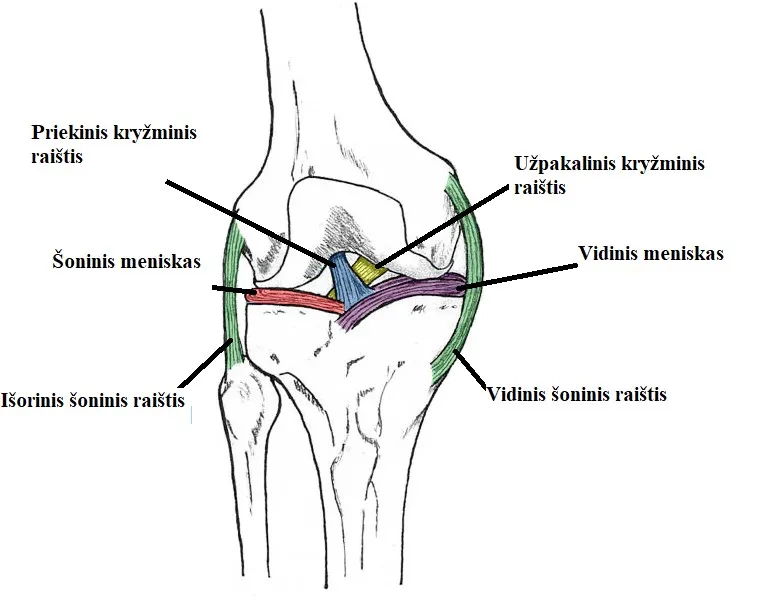
Fig. 1. Anatomy of the knee joint. https://teachmeanatomy.info/lower-limb/joints/knee-joint/ (edited by: Kineziterapijos Klinika).
The knee joint is stabilized by the shape of the tibia and femur bones and the structural parts of the joint (anterior and posterior cruciate ligaments, lateral ligaments, menisci, lateral/posterior part of the joint capsule).
The muscles are responsible for the dynamic or functional stability of the knee joint. The main muscles stabilizing the knee joint - from the front side - the quadriceps femoris muscle, from the back - the "hamstring group" - the biceps femoris, semimembranous and semitendinosus muscles. However, it is very important to mention that the dynamic stability of the knee joint is also greatly influenced by the hip and ankle muscles. The knee joint is between the ankle and the hip, so if we notice poor control of the knee joint during movements, not only the function of the muscles of the knee joint itself, but also the function of the hip and ankle muscles should be evaluated.
Common symptoms of knee instability include:
Pain, swelling after injury. In the case of damage to the anterior cruciate ligament, a "joke" is heard during the injury;
A feeling that the joint will come out of place when performing movements with a load;
Pain during movements;
Decreased range of motion;
Locking, clicking, creaking of the joint (in case of chronic instability).
Rupture of the medial collateral ligament (MCL).
An internal collateral ligament injury occurs when forces are applied to the outside of the knee (i.e. when the knee is pushed from the side to the inside) when the leg is slightly bent at the knee. If the lower leg is turned in relation to the knee at that time, damage to the cruciate ligaments may also occur.
A rupture of the medial collateral ligament causes pain and swelling. The pain is usually localized in the inner part of the knee. There may be looseness when locking the thigh and pushing the ankle outward when the leg is slightly bent at the knee (valgus instability). A radiological examination is performed to confirm the diagnosis.
The treatment is usually conservative - physiotherapy, manual therapy and physiotherapy, but if there is a combined rupture of the internal lateral and cruciate ligaments, surgical treatment (ligament reconstruction) is required.
Fig. 2. Instability of the knee joint after eating. https://www.semanticscholar.org/paper/Current-concepts-review%3A-comprehensive-physical-for-Lubowitz-Bernardini/deeadb455ff368fbb2e2008e1436b35d527ec62d/figure/17 (edited by: Clinic of Physiotherapy)
Anterior cruciate ligament (ACL) tear
Rupture of the anterior cruciate ligament is investigated by performing special tests (Lachman, drawer and pivot shift tests) and confirming the diagnosis with radiological examinations. Depending on the degree of damage (I, II or III), ligament reconstruction is performed, followed by physiotherapy. However, surgical treatment is not always performed. A person's physical activity, risk of injury, age and degree of rupture are evaluated. After evaluating all these factors, non-surgical treatment, with the help of physiotherapy, is chosen in certain cases.
It should be borne in mind that untreated instability of the knee joint can accelerate the degeneration of the joint (menisci, cartilage and other articular structures). In this case, the muscles do not protect and "properly hold" the articular structures, which are overloaded and eventually degenerate. Therefore, once knee instability is detected, physical therapy is always recommended to restore full joint function and prevent further damage to the joint.
Fig. 3. Mechanism of anterior cruciate ligament injury. https://www.sportsinjurybulletin.com/acl-rehabilitation-when-is-your-athlete-really-ready-for-sport/ (Edited by: Kineziterapijos Klinika).
Rupture of the lateral collateral ligament (LCL).
An isolated tear of the external collateral ligament is rare. At the same time, the cruciate ligaments are also torn, and the posterior structural parts of the knee joint are damaged (posterior capsule, tendon of the hamstring muscle, hamstring ligament of the fibula). The injury occurs when a sudden change in the direction of movement occurs when the foot is fixed. Also, experiencing an impact from the inside of the knee.
The diagnosis is established by performing special tests (passive external rotation of the lower leg and varus load test) and radiological examinations. There is pain and swelling. There is looseness when locking the thigh and pushing the ankle inward (varus instability) and rotating the calf while locking the thigh (posterolateral instability).
Depending on the degree of ligament rupture, injuries are treated conservatively, or ligament reconstruction is required, followed by physiotherapy.
Fig. 4. Mechanism of injury of the external lateral knee ligament (action of propulsive force). https://www.businessinsider.com/lionel-messi-prison-sentence-tax-fraud-case-2017-5 (Edited by: Kineziterapijos Klinika)
Posterior cruciate ligament (PCL) tear
Of all knee ligament tears, posterior cruciate ligament tears occur in 20% of cases. The most common mechanism of injury is a fall on a bent knee. A tear can also occur when the leg is bent too much at the knee joint (calf hyperflexion). In this case, only the posterior cruciate ligament tears in isolation, and the instability is not severe. Significant instability occurs if the lateral ligaments are also affected.
Rupture of the posterior cruciate ligament is diagnosed by performing special tests and radiological examination. An isolated tear of the posterior cruciate ligament usually does not require surgical treatment (depending on the extent of the instability). In this case, conservative treatment, physiotherapy is applied. If the cruciate ligament is torn together with the internal or external lateral ligaments, reconstruction of the ligament is performed, after which physiotherapy is continued.
Fig. 5. Mechanism of posterior cruciate ligament injury. https://www.pinterest.com/pin/818670038490303062/ . (corrected by: Kineziterapijos Klinika).
Sources
- Mr. Bruckner. Clinical Sports Medicine. North Ryde: McGraw-Hill Education Australia, 2012. ISBN: 9780070998131.
- R. Good. Sports injuries: diagnosis, treatment, rehabilitation and prevention. Kaunas: UAB "INDIGO print", 2015. ISBN: 978-609-8078-38-1.
- Kakarlapudi, T., K., Bickerstaff, D., R. (2001). Knee instability: isolated and complex. Western Journal of Medicine.
 Joint pain and pathologiesA joint is a complex connection between two or more bones that helps us perform various movements. Each joint consists of cartilage that covers the ends of the bones and reduces the impact force directed at the joint. At the ends of the bone...Read
 Joint painJoint pain is one of the most common problems of the musculoskeletal system. The human body has many joints of different sizes that connect bony structures, help with movement and withstand large loads...Read
 Knee joint painPain in the leg joints (pain in the hip joints, foot joints, knee joints) is a common phenomenon that is faced by more and more people, it is experienced by young, middle-aged and elderly people alike. This happens...Read
 Pain in the joints of the handsPain in the joints of the hands affects people of all ages and often has a strong negative impact on the quality of life. Pain in the joints of the hands can limit both the ability to do physical work - lifting heavy objects, carrying...Read
 Instability of the ankle jointAnkle instability is joint laxity due to damaged/altered joint structures or inefficient muscle function. Ankle instability due to inefficient muscle work is called functional, while due to...Read
 Instability of the shoulder jointShoulder joint instability is much more common than other limb joint instability. This can largely be explained by the anatomical peculiarities of the shoulder joint. The shoulder, due to its structure, can easily be...Read