Instability of the ankle joint
Ankle instability is joint laxity due to damaged/altered joint structures or inefficient muscle function. Ankle instability due to inefficient muscle work is called functional, while due to...
- Topic
- Joints and tendons
- Reading time
- 3 minutes
Ankle instability is joint laxity due to damaged/altered joint structures or inefficient muscle function. Ankle instability due to inefficient muscle work is called functional, while due to damaged structures - tendons, ligaments, bones - structural instability.
Types of ankle joint instability causes
An ankle sprain (when the foot is rolled inward and the lateral part of the ankle is stretched) is a common sports and everyday injury that can lead to joint instability. However, it occurs quite rarely (20% of cases). Instability in this case usually develops due to ineffective post-traumatic rehabilitation.
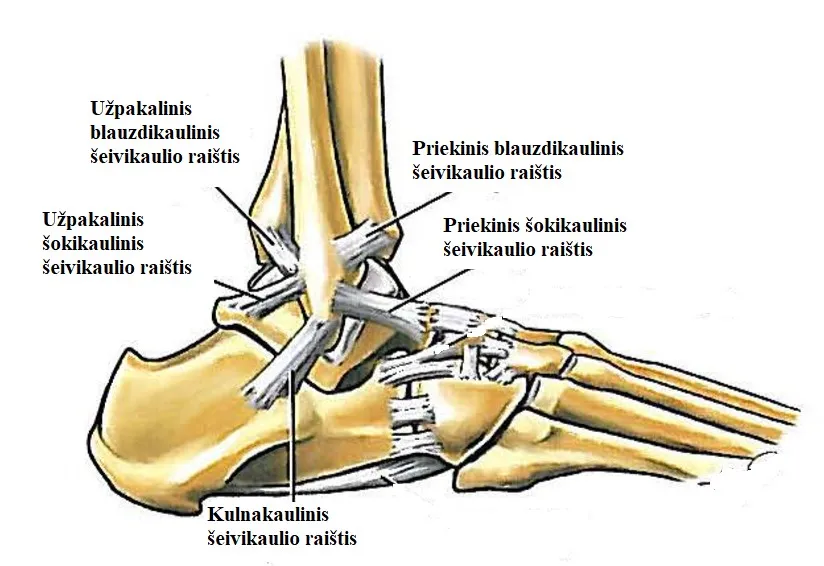
The ankle joint is stabilized by both muscles and ligaments, the most vulnerable of which is the anterior tibial ligament. It is usually stretched by stretching the outer part of the ankle. Meanwhile, a complete tear of the calcaneofibular ligament, posterior fibular ligament, and anterior fibular ligament occurs after ankle dislocation and is accompanied by bone fractures. Such an injury is very rare.
An ankle sprain occurs when a sudden change of direction occurs during a load or when landing improperly on the foot (usually on the outside of the foot).
Instability of the ankle joint is divided into:
Structural (due to laxity or damage to articular structures);
Functional (muscles cannot provide stabilization).
Fig. 1. Structural anatomy. Mr. Bruckner. Clinical Sports Medicine (edited by: "Kineziterapijos Klinika").
Fig. 2. Mechanism of external ankle sprain injury. https://www.healthguideline.net/2019/09/ankle-sprain-recovery-time.html (edited by: Kineziterapijos Klinika)
Structural instability of the ankle is investigated by special tests that are performed passively (by a therapist or doctor). The goal is to determine joint laxity in certain directions. The cause of structural instability is laxity (looseness) or tearing of the ligaments. After acute trauma, structural instability is treated only conservatively, regardless of the degree of ligament rupture (I, II or III). Only if conservative treatment does not help, ligament reconstruction is performed.
The cause of functional instability of the ankle is a previously experienced injury or inappropriate biomechanics of the lower limb, which is determined by the stabilizing function of the muscles. It is detected during physical exertion (for example, standing on one leg with closed eyes or performing a movement) and is treated conservatively. If the cause of this instability is structural instability and conservative treatment does not help, ligament reconstruction is performed.
Common symptoms of chronic instability of the ankle joint:
A feeling of instability during the load;
Pain;
Decreased range of motion;
Repetitive sprains and lack of strength when walking on uneven surfaces;
Joint laxity.
Less common ankle injuries that may be associated with joint instability include:
Medial ankle sprain - when the foot is rolled outwards and the inner part of the foot is stretched. Compared to an external ankle sprain, an internal ankle sprain is very rare. In this case, damage to the deltoid (inner) ankle ligament occurs (and possibly inner ankle instability). Treatment is the same as for damage to the ligaments of the outer part of the ankle, only it takes twice as long;
Pott's fracture - a fracture of the inner or outer ankle with a tear of the corresponding ligament. Depending on the size of the damage, it can be treated surgically or only conservatively;
Maisonneuve fracture. The cause is a severe sports injury or a fall from a great height. Several ligaments are torn and the fibula is broken. In this case, urgent surgical treatment is required.
Fig. 3. Standing on one leg with closed eyes. A test to assess functional stability. Mr. Bruckner. Clinical Sports Medicine.
Excruciating or recurring ankle pain? Do you feel your ankle is unstable? We can help you.
Register: +37068221414
Sources
- Mr. Bruckner. Clinical Sports Medicine. North Ryde: McGraw-Hill Education Australia, 2012. ISBN: 9780070998131.
- R. Good. Sports injuries: diagnosis, treatment, rehabilitation and prevention. Kaunas: UAB "INDIGO print", 2015. ISBN: 978-609-8078-38-1.
- Al-Mohrej, O., A., Al-Kenani, N., S. (2016). Chronic ankle instability: Current perspectives. Avicenna Journal of Medicine
 Joint pain and pathologiesA joint is a complex connection between two or more bones that helps us perform various movements. Each joint consists of cartilage that covers the ends of the bones and reduces the impact force directed at the joint. At the ends of the bone...Read
 Joint painJoint pain is one of the most common problems of the musculoskeletal system. The human body has many joints of different sizes that connect bony structures, help with movement and withstand large loads...Read
 Knee joint painPain in the leg joints (pain in the hip joints, foot joints, knee joints) is a common phenomenon that is faced by more and more people, it is experienced by young, middle-aged and elderly people alike. This happens...Read
 Pain in the joints of the handsPain in the joints of the hands affects people of all ages and often has a strong negative impact on the quality of life. Pain in the joints of the hands can limit both the ability to do physical work - lifting heavy objects, carrying...Read
 Instability of the shoulder jointShoulder joint instability is much more common than other limb joint instability. This can largely be explained by the anatomical peculiarities of the shoulder joint. The shoulder, due to its structure, can easily be...Read
 Instability of the knee jointInstability of the knee joint occurs when the ligaments of the joint (lateral or cruciate) are damaged, and is also reduced if the menisci are damaged or removed. Damage to the ligaments of the knee joint can occur...Read