Elbow joint instability
Elbow instability is a looseness of the joint that can cause pain and a feeling that the joint will "lock" or "go out of place" during movement. Elbow instability usually occurs when the joint is damaged...
- Topic
- Joints and tendons
- Reading time
- 3 minutes
Elbow instability is a looseness of the joint that can cause pain and a feeling that the joint will "lock" or "go out of place" during movement. Instability of the elbow is usually manifested by damage to the joint ligaments, bony structures and joint capsule. This happens during a traumatic event or due to overload. In case of injury, acute instability of the elbow occurs, which can later progress to chronic instability. Overload usually causes chronic instability. Statistically, chronic elbow instability occurs very rarely - both due to trauma and overload, only about 2% of patients experience chronic elbow instability.
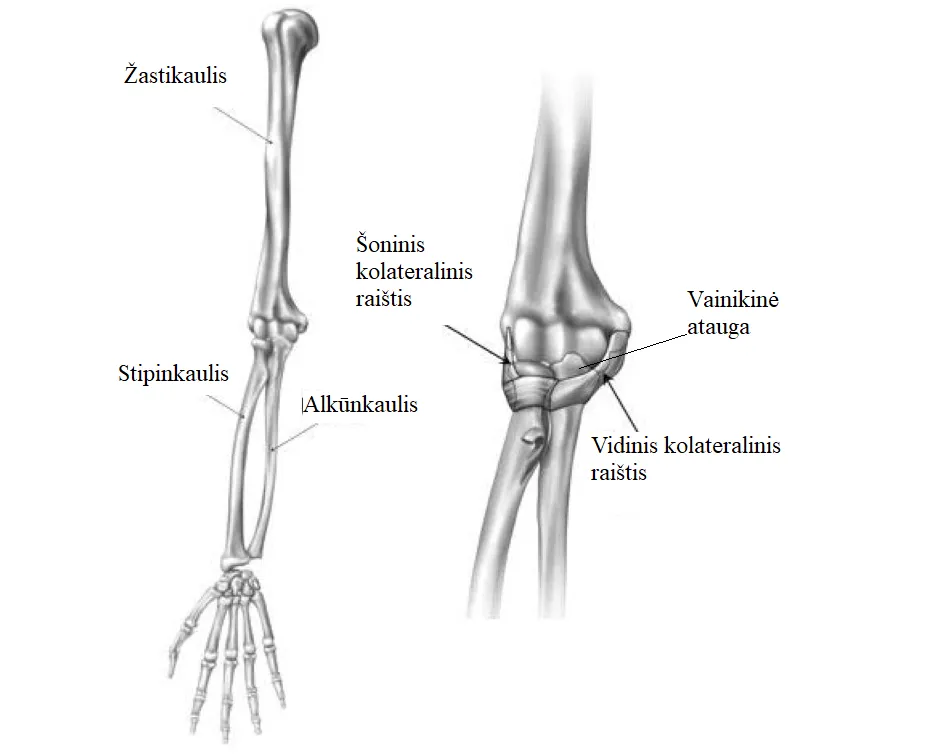
The main structures that stabilize the elbow joint are the complex of internal and external lateral ligaments of the elbow, bony structures (coronoid process of the ulna) and the joint capsule.
Types of elbow joint instability:
- Posterior lateral rotational instability;
- Posterior internal rotatory instability;
- Valgus (internal) instability.
Fig. 1. Elbow anatomy (edited by: Kineziterapijos Klinika).
Posterolateral and medial elbow instability: causes and treatment
Fig. 2. Posterolateral rotatory elbow instability (edited by Kineziterapijos Klinika).
Posterolateral rotatory elbow instability occurs with bone fractures (a transverse fracture of the coronoid process of the ulna) and torn ligaments (a tear of the lateral collateral ligament). The symptoms are easy to feel when doing push-ups or getting up from a chair while pushing off with the hands. The joint is loose and cannot withstand axial load.
Fig. 3. Traumatic mechanism of posterior elbow dislocation (edited by Kineziterapijos Klinika).
The most common cause of this instability is a posterior dislocation of the joint, which can also damage blood vessels and nerves. The injury happens when falling onto an outstretched arm. The elbow bones can break (fractures of the coronoid process of the ulna and of the radial head), and a bone fragment can end up inside the joint space. The lateral collateral ligament of the elbow is damaged.
Fig. 4. Varus (posterolateral) elbow instability (edited by Kineziterapijos Klinika).
If the coronoid process of the ulna breaks on its inner/front part, posteromedial rotatory instability can occur. The symptoms are similar to posterolateral instability, but there is also looseness when the upper arm is held still and the forearm is pushed inwards (varus instability).
After a dislocation, an X-ray examination is done to assess the size and location of the damage. A dislocation does not always cause instability; this depends on whether bones are broken and ligaments damaged. In cases of instability, conservative treatment (physiotherapy) often helps, but fractures are almost always treated surgically. If the lateral collateral ligament is often under load, ligament reconstruction is recommended.
Valgus elbow instability: causes and treatment
Valgus instability occurs when the medial collateral ligament of the elbow is damaged by repeated overhead movements in sport (baseball, javelin throwing) or by an acute injury. The ligament is stretched or may tear. Sport-specific movements cause a feeling of instability and pain. Looseness is felt when the upper arm is held still and the forearm is pushed outwards. A sprain or partial tear of the ligament is treated most effectively with conservative care, i.e. physiotherapy and physical therapy procedures, but a complete tear needs ligament reconstruction.
Fig. 5. Valgus (medial) elbow instability (edited by Kineziterapijos Klinika).
Have you injured your elbow and feel pain? Does the elbow feel loose, and is it hard to lean on the floor or do push-ups?
We work with elbow problems all the time. We will be glad to help you.
We invite you to register: +370 682 21 414
SOURCES
- Mr. Bruckner. Clinical Sports Medicine. North Ryde: McGraw-Hill Education Australia, 2012. ISBN: 9780070998131.
- Comfort, E. Abrahamson. Sports Rehabilitation and Injury Prevention. Chichester: John Wiley & Sons, Ltd, 2010. ISBN: 9780470985625 (HB).
- B. Brotzman, K. E. Wilk. Clinical Orthopaedic Rehabilitation. Philadelphia: Mosby, 2003. ISBN 0-323-01186-1.
- Vaishya, R., Krishnan, M.,Vijay, V., Agarwal, A., K. (2016). A Rare Combination of Complex Elbow Dislocation and Distal Radial Fracture in Adults. Cureus.
- Gud. Sports injuries: diagnosis, treatment, rehabilitation and prevention. Kaunas: UAB "INDIGO print", 2015. ISBN: 978-609-8078-38-1.
 Joint pain and pathologiesA joint is a complex connection between two or more bones that helps us perform various movements. Each joint consists of cartilage that covers the ends of the bones and reduces the impact force directed at the joint. At the ends of the bone...Read
 Joint painJoint pain is one of the most common problems of the musculoskeletal system. The human body has many joints of different sizes that connect bony structures, help with movement and withstand large loads...Read
 Knee joint painPain in the leg joints (pain in the hip joints, foot joints, knee joints) is a common phenomenon that is faced by more and more people, it is experienced by young, middle-aged and elderly people alike. This happens...Read
 Pain in the joints of the handsPain in the joints of the hands affects people of all ages and often has a strong negative impact on the quality of life. Pain in the joints of the hands can limit both the ability to do physical work - lifting heavy objects, carrying...Read
 Instability of the ankle jointAnkle instability is joint laxity due to damaged/altered joint structures or inefficient muscle function. Ankle instability due to inefficient muscle work is called functional, while due to...Read
 Instability of the shoulder jointShoulder joint instability is much more common than other limb joint instability. This can largely be explained by the anatomical peculiarities of the shoulder joint. The shoulder, due to its structure, can easily be...Read