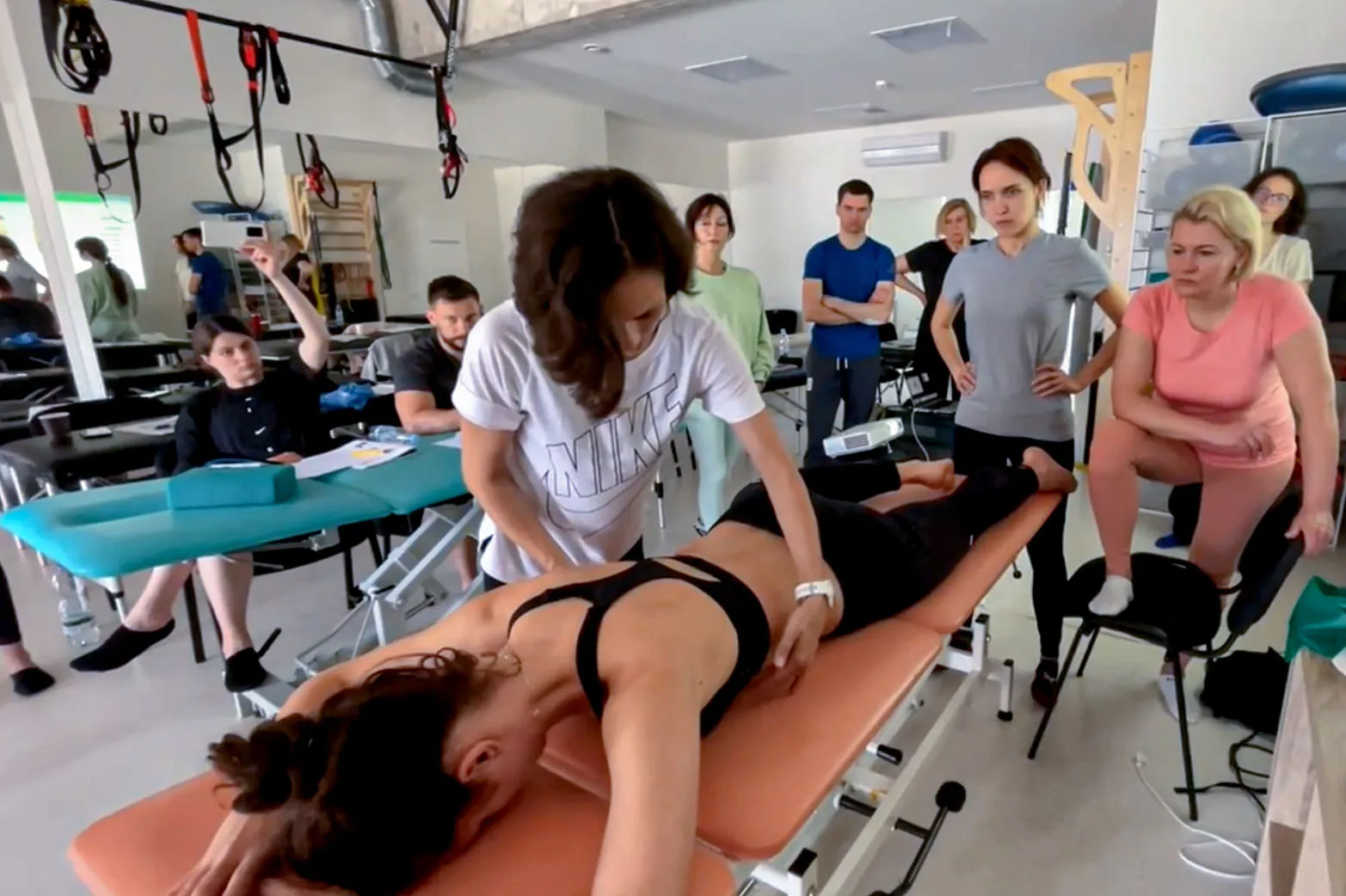
Pain in the lower back
The relevance of the problem of lower back pain is increasing every year due to the increasing sedentary lifestyle. Due to the contribution of the Covid-19 pandemic and non-ergonomic working conditions at home, back pain...
- Topic
- Back pain
- Reading time
- 8 min
The relevance of the problem of lower back pain is increasing every year due to the increasing sedentary lifestyle. Due to the contribution of the Covid-19 pandemic and non-ergonomic working conditions at home, lower back pain has become an even more common problem, which is faced by more than one in ten adults.
Pain in the lower back is a signal that something is wrong in the body. This may be related to overuse of muscles or other structures, but not necessarily to a structural change (such as a herniated disc). The manifestation of pain is a complex mechanism that depends on tissue resistance, health and function, general health status, sleep quality, nutrition, stress, environmental pollution and other factors. If optimal body function is maintained, a person usually does not feel back pain.
However, this does not mean that a structural change in the spine cannot be a source of pain. For example, back pain in the lumbar region or back pain radiating to the leg, leg numbness, decreased leg muscle strength, or skin sensation can be signs of a herniated disc. It is important to understand that a herniated intervertebral disc is a constantly changing formation, the size of which changes over time (decreases or increases) depending on the conditions. A hernia can also become calcified and not change in size.
Radiological studies can show structural changes in the spine, but as we have already mentioned, the identified change does not necessarily mean that it is related to the perceived pain. In order to be able to make a more accurate assumption that the change seen in the image is related to the existing pain, it is necessary to directly irritate the suspected lesion in an interventional way and observe whether the patient's symptoms return. Such invasive methods are rarely used in practice. The findings of radiological examinations are only one (and in most cases rather insignificant) part of the whole examination process.
Causes of lower back pain
The causes of lower back pain can be various. Sedentary work and unsuitable work ergonomics are the most common of them. Lack of physical activity also contributes to this. The spine and the surrounding structures surrounding the spine receive an inadequate load, which over time causes irritation. Unmodified, such a load increases irritation, pain, can cause inflammation, structural changes. Sitting for a long time often without changing the position is not only harmful to the lower back. There may be a burning pain in the upper back or neck, back pain between the years. Further irritation and exacerbation of the affected structure in the upper back may even cause back pain when breathing. The neck and the lower back are closely related and according to statistics, the vast majority of people who have experienced lower back pain in their lives will later experience neck pain as well. This process can also be reversed.
Inadequate physical load (such as heavy physical work or sports) can also cause back pain in the lumbar region. The mechanism is similar - the spine cannot withstand the load, irritation occurs, the body does not have time to adapt to the increased loads and recover, so the damage increases along with the pain. In this case, the back pain may occur immediately during physical activity, which can potentially impair the quality of movement performance, or the back pain may occur after a night the next day. This can occur due to irritation or damage to intervertebral discs, ligaments, muscles, tendons, joints, nerves, blood vessels, skin. Due to the lack of longitudinal compression of the spine, after a night the intervertebral discs fill with fluid and are more swollen. This is a normal phenomenon. As a result, we are one or two centimeters taller in the morning than at the end of the day. However, if the disc is damaged, the hydraulic pressure is more irritating to the damaged area. If the problem is of the origin of the intervertebral disc and the pain is related to its damage, the back pain after the night, when you get up in the morning may be even greater than in the evening, and you may also feel stagnation, pain moving to the buttocks.
Causes of back muscle spasms, tension and weakness. Do you really always need to stretch and massage your muscles?
An intervertebral disc or other structural changes (such as growths, ligament scar tissue, vertebral deformities or trauma) can also irritate the adjacent nerve. Nervous back pain (commonly called nerve back pain) is usually sharp, passing to the leg in one line. Numbness or tingling in parts of the leg may also occur. Imagine that the nerve is like a thread that has to be able to slide, to withstand stretching and compression. If it is irritated or pressed in one place, its mechanical properties may change, causing symptoms. It is necessary to evaluate these mechanical properties before applying the treatment. In the case of such pain, very often people feel stagnation, tension and lack of mobility in the posterior thigh muscle group. This is a protective reaction of the body.
Muscles are tense to protect the nerve from movement to prevent further irritation. Careless stretching of such muscles can worsen the situation and further damage the nerve.
Pain in the lower back indicates a lesion or deficit in neuromuscular control. It usually occurs during a forward bending motion. The risk of such pain is greater when bending forward with a twist and additionally lifting something. Sometimes it can be a heavy object, sometimes it is enough to bend down to tie a shoe. Sudden back pain can also occur during another movement made by the back or after a night. A slight burning sensation may be felt, which passes in the same second. This indicates that the muscles are functionally unable to withstand the possible structural change in the back. Otherwise, the pain can be great, the person can no longer stand up, he can feel "chained". In order to change the position, the movement is very slow and careful, the person is afraid of a repeated episode. This sudden locking of the back occurs as a result of muscle spasm that occurs to protect the spinal structures from further damage. The spasm itself causes pain, although the lesion in the spine may not be irritated. An antalgic position may occur - a person involuntarily stands crooked in order to reduce pain and relieve the irritated structure. In such acute cases, there may be no inflammation. Muscle relaxants or manual therapy often help. However, the necessary evaluation or muscle spasm does not further protect a suspected irritated structural change, such as a sprained or torn ligament. In this case, forcibly relaxing the muscles, for example during a massage, will be doing a disservice.
Lower back pain in women
Pain in the lower back in women can also occur for other reasons, for example, due to menstruation or, of course, pregnancy. This can be a phenomenon of radiating pain, where the source of the pain is not where the pain is felt. In this case, this is a normal and self-limiting phenomenon. However, menstruation can sensitize an existing back problem for the reasons mentioned above. A more detailed investigation and survey would allow for a more objective assessment of the cause.
Back pain after childbirth or back pain during pregnancy is usually related to muscle weakness, hormonal influence, and changes in posture. It is still often heard that after pregnancy one should try to move less, one should not squat deeply, not raise one's hands above one's head, etc. If physical activity is severely restricted during pregnancy, the muscles of the abdominal and pelvic arches stretch and weaken due to the increased belly, while the back muscles have to withstand even greater loads and begin to spasm. Thus, lower back pain becomes a real torment for women, it often hurts all day long, and it is difficult to find a convenient and comfortable place to help. Not to mention that childbirth itself becomes even more complicated, and back pain often persists for at least several months after childbirth. Therefore, the risk of such pain is greatly reduced by performing targeted physical exercises before and during pregnancy and educating the future mother on how to behave during this period.
Back pain after epidural
There are cases when pain at the bottom occurs as a result of direct medical interventions. A very common problem is back pain after an epidural. In this case, the tissues are irritated, which can change the functional expression of the muscles. For example, when stabbing a muscle, its inhibition is possible. Back pain can occur as a result of such inhibition. If the functional expression does not change, but the pain is only due to local irritation at the intervention site, the symptoms should pass by themselves.
When the irritation is acute enough, the pain is felt even when lying down, at rest, at night. This may indicate inflammation. In case of very acute pain, it is recommended to consult a doctor or physiotherapist. If it is a problem of inflammatory origin, it can be solved with medication. Sometimes the structural damage is so great that it is no longer possible to help the person conservatively. You may feel permanent numbness in the leg, lack of strength, numbness in the perineum, incontinence of stool or urine, constant, severe pain in the back, abdomen, legs. In this case, surgical intervention is required.
Back pain and the factors related to it should be recognized in time, because over time the problem can increase and become the cause of illness. Professional physiotherapists with long-term experience in pain management work at the Kineziterapijos Klinika in Kaunas, who will assess your problem personally and help restore the quality of life without pain.
 Back painBack pain is one of the most common problems for which health professionals are consulted. It is the most common musculoskeletal disorder and one of the most pressing problems of modern medicine...Read
 Back pain: doctor advisesBack pain is a very common problem that affects over 80% of people in their lifetime. It is very closely related to the occurrence of various biopsychosocial factors that lead to back pain problems...Read
 Back pain treatmentBack pain is the most common problem of the musculoskeletal system, and the second most common (after joint problems and osteoarthritis) for which health professionals are consulted (1). Back pain at least once a...Read
 Back hurts - what to do?Back pain is the most common problem of the skeletal muscle system, which about 90% of people encounter at least once in their lifetime. Every tenth adult complains of back pain, but seeks help...Read