Massage: classic, therapeutic, sports
Classic, therapeutic and sports massage, individually tailored for neck, back, shoulder, waist and leg pain.
- Price
- from €50
- Duration
- 1 hour - 90 min.
- Opening hours
- Mon-Fri 08:00-20:00
Prices
| Service | Duration / quantity | Price |
|---|---|---|
| Full body massage | 1 hour - 90 min. | 70 € |
| Back and neck massage | 45-60 minutes | 50 € |
| Shoulder straps and hand massage | 30 minutes | 30 € |
| Foot massage | 30 minutes | 30 € |
| Classic facial massage | 30 minutes | 30 € |
| Kobido facial massage | 60 minutes | 70 € |
| Kobid facial massage subscription | 6 k. | 50 €/person (€300) |
Summary: Massage - what you should know
Massage is a very versatile means of rehabilitation. It can be tonic (activating) or relaxing, preparatory or restorative, performed with auxiliary devices and instruments or only with the therapist's hands, etc. The main types of massage are classic (Swedish), sports and therapeutic. Classic massage is a more relaxing and preventive measure, during which blood circulation is improved, psychological muscle tension is reduced, etc. Sports massage is a restorative and preparation tool, mainly intended for athletes and active sportsmen. Meanwhile, therapeutic massage is a therapy focused on the patient's problem. The main goal of therapeutic massage is to find out the cause of the problem and eliminate it or restore and improve the damaged functions of the body.
There are hundreds of different massage techniques and methodologies. Their application depends on the patient's problem. There is no one universal or best technique suitable for all problems. The most popular therapeutic massage techniques: trigger point massage, deep tissue massage, point massage, lymphatic drainage massage, Myofascial release, scar tissue massage. However, even the most popular techniques are often confused with each other, although their philosophy, performance and effects are radically different. Without understanding the physiological effects of massage and mixing different techniques with each other, it is not worth expecting a positive result.
In general, massage is a very effective and widely applicable rehabilitation tool. With its help, various back, neck, limb, muscle pains can be solved; circulatory and lymphatic circulation, nervous system problems; speed up rehabilitation after injuries and operations, etc. However, massage should not be considered a panacea. In some cases, massage can only temporarily relieve the symptoms, and in others, it can even worsen the situation. Therefore, a detailed oral and physical examination of the patient is necessary before choosing and applying any treatment method. In other words, before starting treatment, it is necessary to find out the cause of the problem.
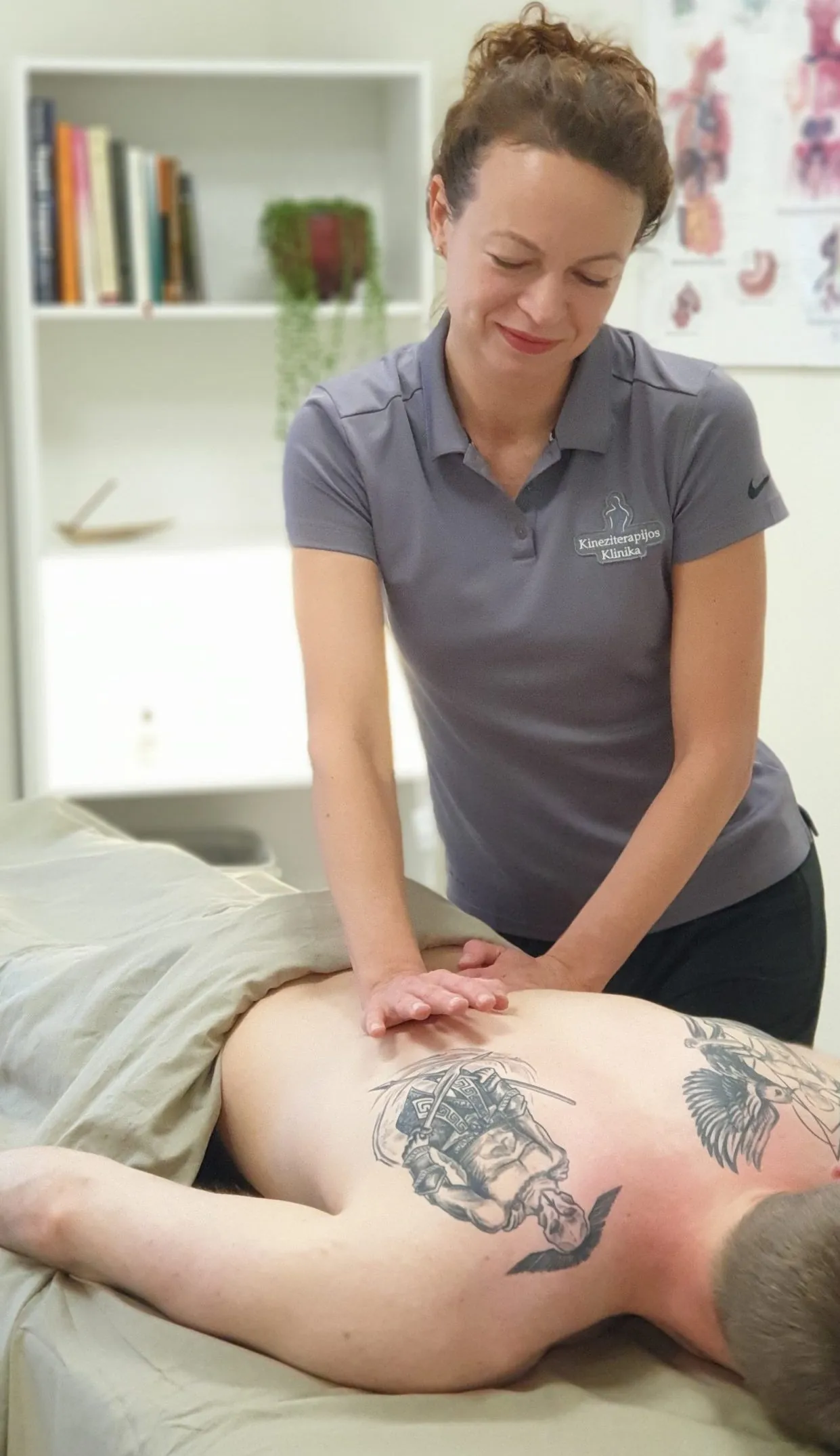
Massage in Kaunas, at the "Kineziterapijos Klinika" is performed only by professional physiotherapists who have not only massage, but also manual therapy knowledge and skills. Before starting any therapy or treatment, we first perform a thorough interview and a detailed physical examination of the patient. After finding out the cause of the problem, the treatment is much more effective and faster.
Types of massage
The physiotherapy clinic widely uses classical, therapeutic and sports massage in its practice.
Each type and technique of massage has a specific effect that can help solve certain problems. However, massage also has general benefits that practically do not depend on the applied massage method. During the massage, muscle tension is released, blood circulation is activated and improved, the nervous system is calmed, and neck, back, shoulder, waist, and leg muscle pains are suppressed.
Massage techniques, which are individually adapted to each person, not only improve well-being, but also heal, reduce fatigue, improve psychological and physical well-being, and help regain working capacity.
Classic massage
Classic massage, otherwise known as Swedish massage, is one of the most popular and commonly used types of massage. The main goal of a classic (Swedish) massage is to relax the body, improve blood circulation, and reduce psychological and muscle tension. Classic (Swedish) massage is usually performed on the whole body, but possibly more concentrated on the more tense body area. Performing a massage - gentle, without applying great force and performed sufficiently shallowly - the skin and surface tissues are massaged, performing stroking, rubbing, softening, vibration techniques.
- During the stroking technique, hand movements easily slide over the body surface, activating skin breathing and blood circulation.
- When performing the rubbing technique, the specialist moves his hands on the surface of the skin in the direction of lymph movement or in the opposite direction, improving blood flow to tissues, muscle strength, stretching scars caused by trauma or surgery.
- By applying massage and using its various techniques, muscle fatigue is reduced, their tone is increased, ligaments are stretched, and the elasticity of tendons is improved.
- During the vibration technique, vibrations of various frequencies and amplitudes are transmitted over the surface of the body, which affect not only the surface of the massaged body, but deeper tissues, which reduces pain, improves the ability of muscles to contract, and tissues recover faster after injury.
In order to achieve the best effect and a specific desired result, during one procedure, massage can be performed with several techniques, alternating between them.
Sports massage
Sports massage is a specific form of massage used to prepare athletes to prevent injuries, as well as to restore the body after heavy physical exertion and rehabilitation after sports injuries. As the goals of the athlete increase, the intensity of physical activity increases, in order to improve results, great strength, endurance, flexibility, speed are used. However, tension in the soft tissues can cause imbalance and increase the risk of injury. Sports massage helps to avoid all this.
Sports massage is divided into restorative, preparatory, training, therapeutic and spot massage.
- Restorative sports massage is used for recovery after heavy physical exertion (intense training, competitions).
- Preparatory massage is performed before training or competition. During it, a warming or toning massage procedure can be applied.
- Training massage is performed during training in order to achieve the best sports form, in order to strengthen the athlete's joints, ligaments, and muscles.
- Therapeutic massage for an athlete is performed when the athlete has a certain problem - illness, injury or pain.
- Point massage is used as an auxiliary tool for other types of massage or to affect biologically active points separately.
Therapeutic massage
Therapeutic massage - is focused on a specific problem of the patient, helps to effectively reduce pain and achieve positive results in the treatment of various diseases and restore damaged functions of the body. Unlike classical massage, therapeutic massage is usually performed on a certain area of the body related to the patient's problem (rather than massaging the whole body).
During the therapeutic massage, soft tissues are mobilized - skin, muscles, connective tissue, thereby affecting not only the bone-muscle, but also the nervous, circulatory, and lymphatic systems. A specialist, performing a therapeutic massage, finds the problem of soft tissues (skin, fascia, muscles) and removes it. Therapeutic massage also suppresses pain, which can cause persistent nervous system irritation, which can lead to excessive and inadequate pain. Therapeutic massage also improves blood circulation, stimulates the supply of oxygen and nutrients to the tissues, and has a positive effect on the immune system. Therapeutic massage is especially effective and important after injuries and operations, when scar tissue and adhesions are formed, which must be mobilized to restore impaired function.
With the help of therapeutic massage, it is possible to restore and increase the flexibility and mobility of the joints, mobility and elasticity of the skin and subcutaneous tissue, relax overstretched and spasmodic muscles and remove metabolic by-products, including toxins, from the tissues. Therapeutic massage is used to reduce back and headache pains, to treat various muscle injuries (strains, tears, contractures), in case of joint stiffness, to correct posture disorders, for rehabilitation after various injuries and operations, to improve and restore the function of blood circulation and lymphatic circulation.
Also, therapeutic massage is recommended as a preventive measure for people who work in a sedentary position for a long time.
It is very important to mention that in order to properly perform a therapeutic massage, first of all, a detailed examination of the patient is very important, during which it is necessary to find out not only the area of the body (structure) causing pain, but also the cause of the pain, which is usually related to lifestyle, disease or trauma. Performing a therapeutic massage without finding out the problem and its cause may not only not give the desired result, but also worsen the situation. Specific reasons and examples are provided in Is massage always the best treatment for pain? in the paragraph.
Classic facial massage
Classic facial massage is a scientifically based procedure designed to improve surface blood and lymph circulation, reduce soft tissue tension and maintain normal facial tissue function. During the procedure, classical massage methods are used, which help to relax the muscles of the face, neck and décolleté area, improve tissue supply with oxygen and nutrients, and stimulate natural regeneration processes.
A regular classic facial massage can help reduce facial muscle tension, improve skin tone and elasticity, reduce puffiness, and give the skin a healthier and more vibrant appearance. The procedure also has a positive effect on general well-being - it reduces stress, promotes relaxation and improves psycho-emotional condition.
Kobido facial massage
Kobido is a traditional Japanese facial massage that combines deep soft tissue, fascia and lymphatic drainage techniques. In the physiotherapy clinic, this procedure is performed based on the knowledge of anatomy and functional tissue principles, so attention is paid not only to the aesthetic result, but also to improving the function of the face and neck tissues.
During the procedure, facial and masticatory muscle tension is reduced, blood circulation and lymph flow are improved, and natural tissue regeneration processes are stimulated. Massage can help reduce puffiness, improve skin tone and elasticity, relax tense tissues and give the face a fresher and more vibrant appearance.
Kobido massage is especially recommended for people who feel tension in the face, jaw or neck, are under stress, grind their teeth (bruxism), have a sedentary job or are looking for natural, non-invasive facial care that supports skin firmness and facial contour. The procedure helps to relax, improves general well-being and restores the balance of facial tissue functions.
Kobido massage performed by a physiotherapist stands out from a holistic point of view - not only the face is evaluated, but also the function of the neck and shoulder girdle, because the tension in these areas can have a direct impact on the condition of the facial tissues. It is a procedure that combines therapeutic effects, deep relaxation and aesthetic benefits.
Massage of individual parts of the body:
Neck, shoulder girdle, back, leg and hand massages are well known to everyone, so it probably doesn't make sense to talk about the specifics of massage for each of these body parts. However, foot and head massage is not so widespread and accessible to everyone, although it can be a very effective tool for solving certain specific problems, such as headache, heel pain, plantar fasciitis, etc.
Head massage is quite a forgotten tool, especially in physical medicine and rehabilitation, although it was used in alternative medicine several thousand years ago. The effect of head massage is supported by recent scientific articles. Recent scientific studies show that head massage can affect the nervous and cardiovascular systems by positively stimulating the parasympathetic nervous system, reducing the level of stress hormones such as adrenaline and cortisol, blood pressure and cardiac seriousness (Fazeli et al. 2015; Kim et al. 2016; Murota et al. 2016). Also, there is scientific data that head massage can be an effective means of preventing hair loss by increasing hair density and thickness (Koyama et al. 2016).
Foot massage can be evaluated and performed in two quite different ways. The first is called reflexology foot massage, according to which each internal organ has a point on the foot that represents it, which can be directly affected by stimulation of that organ. The practice of reflexology massage claims that this type of massage can be effective in the treatment of diseases and disorders such as stroke, multiple sclerosis, migraine, peripheral neuropathies, etc. However, recent meta-analyses reviewing scientific studies analyzing this massage method have so far been unable to confirm either the theoretical physiological mechanisms or any positive effects (McCullough et al. 2014; Embong et al. 2015, 2017). However, massage specialists using this method are convinced of the effectiveness of this massage, and individual clinical cases of patients show that under certain circumstances or by specialists of a certain skill, reflexology massage can indeed be very effective. So probably reflexology massage has its place in the rehabilitation process, but both its effects and physiological mechanisms of action have not been scientifically proven and substantiated. The second is a traditional, manual foot massage designed to solve certain local foot problems. A foot massage can use a variety of massage techniques and can address a wide range of lower extremity pain. Although foot massage cannot always help to solve pain below the knee, in general, manual foot massage is an effective tool in the treatment of pathologies such as plantar fasciitis (Yelverton et al. 2019) or heel pain (Pollack et al. 2017).
Massage techniques and methods
There are hundreds of different massage methods and techniques. It is impossible and probably pointless to review all of them. However, it is important to at least briefly touch on the most popular and most applicable therapeutic massage methods in physical medicine and rehabilitation and review their advantages and disadvantages.
Deep tissue massage
Deep tissue massage - a method whose performance is similar to classic (Swedish) massage, but performed a little stronger, trying to affect not only the superficial but also the deeper tissues. Although the deep tissue massage is a bit more intense and may occasionally cause discomfort, there is often a misconception that during and even after this massage you feel a lot of pain, and the intensity of the pain is directly proportional to the effect of the massage (the more it hurts, the better). Another myth is that by pressing hard and very deeply, you can relax even the deepest muscles right next to the spine, such as the multifidus or rotatores muscles. Although a general decrease in muscle tone and muscle relaxation can be expected with the help of massage by affecting the nervous system, the layer of tissue between the therapist's fingers and many muscles is so thick that direct relaxation of these muscles should not be expected.
Trigger point massage
Trigger point massage is a method used to treat myofascial pain syndrome. Simply put - to eliminate the pain caused by the trigger point. A trigger point is a painful or irritated point in a certain muscle (usually one that is tense). Most often, during trigger point massage, after finding a trigger point, the ischemic compression method is used to remove it, when blood flow is locally disrupted at the point. By reducing the blood flow in the trigger point area, the muscle is inhibited, which reduces the sensitivity of the point and the pain gradually disappears. Therefore, trigger point massage is a simple, yet quick and effective way to relax overstretched muscles and relieve their pain. However, trigger point massage very rarely (practically never) helps to solve the cause of the problem, but rather only helps to reduce the symptoms. The most common cause of trigger points is weak and unstable muscles. Therefore, while removing a trigger point in a weak muscle may both temporarily reduce pain and increase strength in that muscle, there is a high chance that the problem will recur after some time. Therefore, although trigger point massage can be a quick and effective tool for reducing pain and muscle tension, it should not be used as a single tool, but in a complex way with other rehabilitation and therapy tools in order to eliminate the cause of pain and ensure maximum treatment efficiency.
Point massage
Point and shiatsu massage. Acupressure is often confused with trigger point massage. Although both the name and performance are similar, these two massage techniques are fundamentally different. Point massage is one of the already mentioned methods of reflexotherapy. It is an ancient Eastern medicine method, according to the philosophy that there are 600-700 biologically active points in the body, each of which is related to a certain organ, and when a point is properly stimulated, the related organ will also be affected. Reflexotherapy points can be affected in various ways - needles (acupuncture), heat (moksha therapy), light, electric current, etc. In the case of point massage, they are affected by the masseur's hands. There are especially many biologically active points on the palms, feet, ears, as well as on the face and head. Therefore, point massage is usually performed in these places. It is claimed that point massage helps to treat a wide range of chronic diseases - starting with headaches and ending with disorders of the cardiovascular and respiratory systems. Therefore, it should not be confused with trigger point massage, because these massages solve problems in fundamentally different ways. Shiatsu massage is a Japanese point massage technique, also called classical Japanese massage. Shiatzu massage, due to the performance of its technique, is usually performed on the ground, and its name betrays the performance of the method - "shi" and "atsu" translated means "finger pressure".
Lymphatic drainage massage
Lymphatic drainage massage is intended for the treatment of disorders of the lymphatic system (and venous circulation). Often after operations (especially oncological ones), musculoskeletal injuries, removal of lymph nodes, stroke, etc. lymph circulation is disrupted and lymphedema develops. Limbs, and especially legs, begin to swell, excess fat tissue is formed, skin changes appear, and cellulite develops. In such cases, lymphatic drainage massage is used, the main purpose of which is to stimulate the flow of lymph towards the heart. With its help, lymph stasis (accumulation) is reduced, the elimination of toxins and other by-products of metabolism is accelerated, and it helps to restore the impaired function of the lymphatic system. However, although lymphatic drainage massage is truly effective, it is often insufficient as a single remedy for lymphatic system disorders. Therefore, complex treatment is recommended for the treatment of more serious lymphatic problems, which includes not only lymphatic drainage massage, but also physiotherapy, compression therapy, skin care and a special diet. Both manual (performed by a therapist) and hardware (using a lymphatic drainage pressotherapy device) methods are used to perform lymphatic drainage. Although their purpose is similar - to stimulate the flow of lymph towards the heart, the effects are slightly different, so one method is more advisable for one disorder, the other for others (for example, in the case of varicose veins, lymphatic drainage performed by a therapist is more recommended), or both are used in a complex manner.
Myofascial release
Myofascial release is often used synonymously with deep tissue massage. However, although both methods are very similar - they are not the same. Deep tissue massage - usually performed by a therapist and only passively - without the patient moving. Meanwhile, myofascial relaxation can be performed both actively and passively and often with the use of auxiliary means - massage balls, rollers, etc. Myofascial massage can be performed by the patient himself, so a therapist is not always needed. During active myofascial massage, soft tissues are pressed or stretched and active movements of the patient are performed at the same time. This creates a double effect. During passive massage, the patient is completely relaxed and the therapist performs soft tissue mobilization (or the patient himself using an auxiliary device, but not moving). The main purpose of myofascial massage is to "break" the adhesions between the subcutaneous tissue and the deep fascia covering the muscle, thus improving the movement of tissues among themselves and joint mobility. However, recent research shows that "breaking" adhesions between these layers is much more complicated than previously thought and is probably only possible through active myofascial massage ( Spina, 2012 ). And the "stretching" of the fascia and the breaking of the adhesions in the fascia itself are generally questionable, because this structure is very rigid and in order to stretch it, even several times greater forces are needed than what the therapist and the aids can cause (Wilhelm et al. 2017). The actual physiological mechanism of myofascial release: a) the adhesions between the superficial (subcutaneous) and internal fascial layers are broken and b) the cells that produce the fascia (fibroblasts) eventually change the composition of the fascia, but this effect requires a long time and a high number of repetitions. Myofascial massage can also speed up muscle recovery and reduce muscle soreness after exercise (Cheatham et al. 2015).
Scar tissue massage
Scar tissue massage is very important for two reasons. First, the resulting scar tissue is very hard and stiff, and hardens even more over time. An immobile scar grows with the deeper layers of the subcutaneous tissue and not only restricts movements, but also causes pain and discomfort. Due to the fact that the internal environment of the body has been invaded (and in the case of a surgical incision - even very large), the body defends itself against possible repeated damage of a similar nature. Muscle tone changes, their imbalance occurs, secondary problems (dysfunctions) may occur. It is advisable to massage any scar tissue, whether it is a surgical incision or a larger skin abrasion that has resulted in a scar. Various techniques are used to massage the scar - lifting the tissue, stretching it in different directions, etc.
Is massage always the best way to treat pain?
There is an opinion in society that when there is pain or muscle tension in one place or another (especially the back), a massage should be performed first and massage is the best way to solve the problem. While this may be true, it certainly shouldn't be considered a rule. Although massage is an important part of rehabilitation and can be a very effective way to treat certain problems, it is probably one of the aids and not the only solution.
First of all, as we have already mentioned, in order to properly perform a therapeutic massage, a detailed examination of the patient is very important. Performing a therapeutic massage without finding out the problem and its cause may not only not give the desired result, but also worsen the situation. For example, in the case of a herniated intervertebral disc, lumbar massage is often used, which relaxes the tense muscles of the lumbar spine. However, the possible muscle tension is a protective reaction of the body, the function of which is to protect the damaged disc and nerve from repeated irritation. Therefore, increased muscle tone is necessary to create the right conditions for the healing of damaged structures. In this case, relaxing the lumbar muscles may temporarily improve the patient, but it increases the risk of re-injury and only worsens the problem in the long run.
Another relevant example is chronic pain. Chronic pains are often related to lifestyle - constant repetitive movements (monotonous actions related to work), long static positions (sitting), etc. These loads lead to muscle overload and tension. But most of the time, overload and tension are caused by the fact that the muscles are simply too weak and overloaded. Massaging them will give only a short-term effect and the pain will return again. Therefore, in this case, attention should be paid to strengthening muscles and changing daily habits, and massage can only be an additional, but not the main, tool.
Massage procedures at "Kineziterapijos klinika" in Kaunas
In the "Kineziterapijos klinika" in Kaunas, massage is performed only by professional physiotherapists who have knowledge and skills not only of massage, but also of manual therapy and movement therapy. Massage manual therapy is complemented by a detailed examination and a completely different understanding of pain and its sources. And physiotherapy provides tools not only to relax, but also to strengthen the human body, activate the necessary muscles, understand their stresses and dysfunctions. Before each procedure, the patient is examined in detail and the causes of pain are determined. Only then is the most suitable massage method and duration chosen to solve the problem, which are very individual. Of course, in the case of classical massage, when the massage is performed for relaxation purposes, a detailed examination is not necessary. Simona Snarskienė, massage therapist and physiotherapist of "Kineziterapijos klinikos" in Kaunas, applies massage techniques in combination with "Maitland" and "Mulligan" manual therapy and various methods of orthopedic physiotherapy.
Frequently asked questions
Prices start from 50 €. All prices are listed in the price table on this page.
Full body massage: 1 hour - 90 min.
Back and neck massage: 45-60 minutes
Shoulder straps and hand massage: 30 minutes
Foot massage: 30 minutes
Germante Šutinytė, Physiotherapist, massage therapist
A. Juozapavičiaus pr. 31-8, Kaunas. Open Monday to Friday, 08:00-20:00; closed at weekends.
Book online through the manodaktaras.lt booking system or call +370 682 21 414.