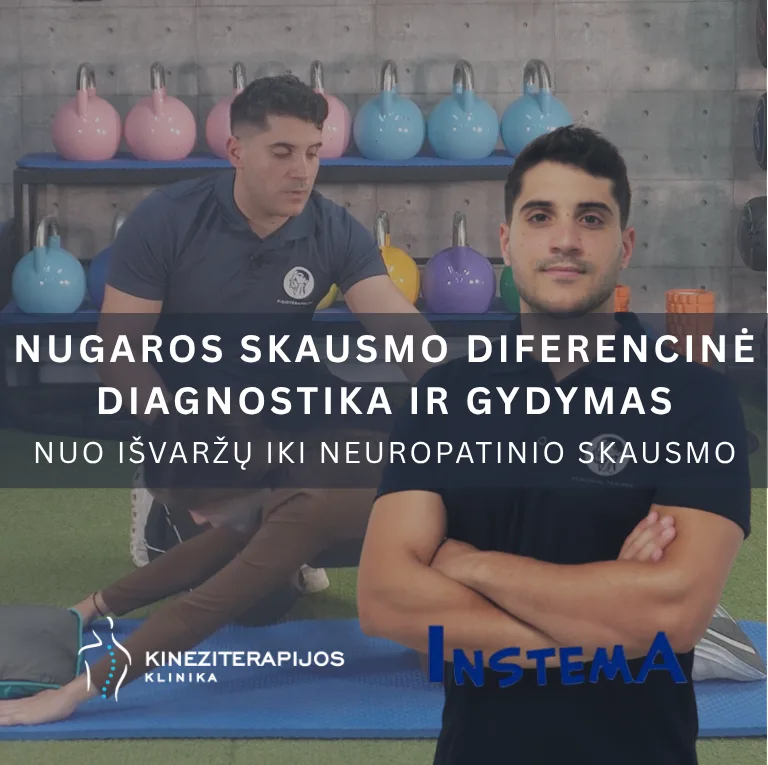
Differential diagnosis and treatment of back pain: from herniations to neuropathic pain
- Price
- 550 €
- Date
- Past
- Venue
- Kaunas
Dates, plans and prices
Differential diagnosis and treatment of back pain: from hernias to neuropathic pain
We don't have
In these trainings, together with lect. Joan Boscà Pardo, you will learn a modern, evidence-based and clinical approach to the treatment of low back pain with therapeutic exercises. You will learn how to safely, effectively and individually select exercises and how to integrate them with manual therapy and patient education about pain to achieve the best treatment results.
Upcoming events: - Differential diagnosis and treatment of back pain: from hernias to neuropathic pain: 2026 October 9-11
About the seminar:
Low back pain is one of the most common reasons to see a physical therapist, but it is also one of the most complex clinical problems. There are still many misconceptions and myths surrounding low back pain. In addition, the lack of clear criteria for the proper selection and dosage of exercises often creates uncertainty for both specialists and patients.
What will you learn?
- The role of therapeutic exercises. You will understand the precise role of therapeutic exercises in the treatment of low back pain and how to properly integrate them into an overall treatment plan.
- Advanced clinical thinking. You will learn to distinguish between different types of pain and analyze the factors that influence its occurrence, so that you can optimally plan your treatment.
- Integration of the three main components of modern treatment. You will learn to successfully combine the three main elements of the modern approach: patient education about pain, manual therapy and therapeutic exercises.
- Debunking myths. You will understand the real impact of physical activity and therapeutic exercises on function and quality of life and learn to distinguish real risks from unfounded beliefs about supposedly "harmful" movements for non-specific low back pain.
- Effective anamnesis. You will learn to ask the most important questions of both yourself and the patient that help you make informed clinical decisions.
- Compilation of specific exercise programs. You will learn to create individualized training programs both for non-specific low back pain and for specific pathologies such as intervertebral disc herniation, radiculopathy, etc.
- True customization. You will learn how to adapt exercises to different patients, from athletes, depending on the specifics of their sport, to patients experiencing kinesiophobia, where the focus is on overcoming the fear of movement.
- Proper application of coaching principles. You will learn to apply basic training principles - specificity, progression, overload and continuity - to optimize patient recovery.
- Patient engagement and continuity of care. You will learn how to manage the expectations of patients who expect manual therapy alone and how to apply strategies to ensure long-term patient engagement and adherence to the treatment plan.
- Improving therapeutic communication. Improve the way you explain the patient's condition and the intended treatment plan. This is a critical skill that is often overlooked, but can make a significant difference in treatment outcomes.
The purpose of the seminar:
Training focused on clinical thinking rather than rote memorization
These trainings are not designed to give you a list of repetitive exercises. The most important thing is to understand how the body reacts to movement, how to properly dose physical exertion and how to adapt it to the real needs and goals of each person.
After completing this training, you will have a clear and practically applicable methodology that allows you to assess the patient, plan and apply individual programs of therapeutic exercises. You will gain more clinical confidence, improve patient engagement and increase treatment efficiency.
If you want to develop personalized treatment strategies that combine scientific evidence, clinical thinking and practical experience, this training is for you.
After the course, participants will be able to:
- To understand the mechanisms and types of low back pain, to distinguish between its different clinical expressions and to understand their significance for the choice of treatment.
- Apply evidence-based clinical thinking to consider biological, psychological, and social factors in decision-making.
- Recognize the three main components of the modern approach to low back pain treatment: therapeutic exercise, manual therapy, and patient education about pain, understanding the role and limitations of each.
- Perform a clinical assessment of the patient, focused on the selection of therapeutic exercises, using effective anamnesis, questionnaires and functional assessment tools.
- Identify and address misconceptions and psychosocial factors that may influence the course of low back pain and its chronicity.
- Understand the physiological and clinical effects of therapeutic exercises, as well as their impact on pain, physical function, quality of life and relapse prevention.
- Disprove traditional myths about supposedly harmful movements and exercises based on modern scientific evidence about exercise and body adaptation.
- Individually prescribe therapeutic exercises, taking into account the characteristics, goals, wishes and individual context of each patient.
- Apply basic training principles and FITT-VP variables, properly dosing physical exertion and using measures such as RPE, RIR and subjective perception of exertion scales.
The seminar is intended for: - Physiotherapists; - for occupational therapists; - For manual medicine specialists; -Masseurs; - For doctors;
Licensing: The seminar is accredited and registered in the METAS system, the certificates are suitable for obtaining/extending the licenses of doctors, physiotherapists, occupational therapists.
Seminar price: Registration by October 1. - discount applies - price 450 Eur! Registering from October 1. - price 550 EUR.
SEMINAR PROGRAM:
MODULE 1. BASIC PRINCIPLES OF THERAPEUTIC EXERCISES
- Therapeutic exercises
- Basic principles of coaching
- Therapeutic exercises and the FITT-VP principle
MODULE 2. WHAT IS PAIN AND TYPES OF PAIN
- Classification of pain
- Central sensitization
MODULE 3. LOWER PAIN
- Review of the basics of spine anatomy
- Muscle pain
- Pain caused by facet joints
- Discogenic pain without compression of nerve structures
- Discogenic pain with compression of nerve structures
- Lumbar canal stenosis
- Visceral pain
- Inflammatory pain
- Psychogenic pain
- Differential diagnosis of other pathologies
- Radicular pain
- Radiculopathy
- Reflected pain
- Limitations of the term "sciatica".
- Combinations of clinical conditions
- Definition and main characteristics
- The relationship between pain and tissue damage
- The role of imaging studies
- Risk factors
- A biopsychosocial approach
MODULE 4. 3 BASIC PRINCIPLES OF TREATMENT OF NON-SPECIFIC LOW BACK PAIN
- Manual therapy
- Patient education about pain and recommendations for prescribing exercises for low back pain
- A multidisciplinary approach
- Individualization of treatment
- Patient beliefs and expectations
- Teaching the neurophysiology of pain during patient education
- Engaging in physical activity and exercise.
- Clinical communication.
MODULE 5. THE EFFECTS OF EXERCISE THERAPY IN PEOPLE WITH LOW BACK PAIN
- Pain reduction.
- Improvement in physical function.
- Relapse prevention.
- Increasing muscle strength.
- Improving flexibility.
- Psychological benefits.
- Improving the quality of life.
ARE THERE EXERCISES THAT CAN BE HARMFUL?
- Myths and facts.
- Exercise technique and load dosage.
- Deadlift and lower back pain.
- Lifting weights and loads in everyday life.
IMPORTANT QUESTIONS
- Clinical interview.
- Key questions in the recovery process.
QUESTIONNAIRES
- DN4 - neuropathic pain assessment questionnaire.
- SF-36 - health-related quality of life assessment questionnaire.
- Roland-Morris - questionnaire for assessing the impact of low back pain on physical function.
MODULE 6. SHORT-TERM THERAPEUTIC EXERCISE PLANNING FOR NON-SPECIFIC LOW BACK PAIN
- General principles.
- Engaging in and adhering to a therapeutic exercise program.
- Variables to consider when prescribing exercises.
THERAPEUTIC EXERCISES AND THE FITT-VP PRINCIPLE
- Frequency (Frequency).
- Intensity (Intensity).
- Duration (Time).
- Exercise type (Type).
- Volume (Volume).
- Progression.
IMPORTANT TERMINOLOGY
- RIR (Reps in Reserve) - reserve of repetitions, i.e. i.e. how many more repetitions could be done before muscle fatigue.
- RPE (Rating of Perceived Exertion) - assessment of subjectively perceived intensity of physical exertion.
- Borg's scale - a scale for evaluating the intensity of subjective physical exertion.
- VAS/EVA - visual analogue pain scale.
- 1RM (One Repetition Maximum) - the maximum weight that can be lifted in one exercise.
MEASURES USED
- Elastic resistance bands.
- Dumbbells.
- Barbells and weight plates.
- Kettlebell (forest).
- Body weight.
EXERCISE PROGRESSION AND INCREASING COMPLEXITY
- Gradually increasing the difficulty of the exercises.
- Increasing load and resistance.
- Progression of exercise volume and intensity.
PRACTICAL CASES AND CLINICAL APPLICATION
- Compilation of therapeutic exercise programs.
- Adaptation of the program according to the patient's individual profile.
- Exercise progressions and regressions.
- Monitoring of the patient and evaluation of treatment results.
LECTURER:
Joan Boscà Pardo
Physiotherapist, physical training trainer, functional rehabilitation specialist. Instructor at INSTEMA International (conducts training in Bahrain, Switzerland, Turkey, Italy, India, Saudi Arabia, Slovakia, Kuwait, Portugal, Bosnia and Herzegovina and Croatia). Obtained bachelor's degrees in physiotherapy, physical activity and sports science. He also completed postgraduate studies: "Therapeutic exercises for patients with pain in the musculoskeletal system", "Structural osteopathy applied to sports", "Orthopedic manual therapy (OMT) applied in physiotherapy".
More information: phone +370 60344761 or email info@kineziterapijosklinika.com
More in this category
Finding the source of neck pain: treatment methods and case analysis
A theoretical/practical, evidence-based workshop for physiotherapists, massage therapists, doctors, sports specialists, occupational therapists working with patients with neck problems and related symptoms
150 €November 28
Finding the source of back pain: clinical reasoning and treatment methods (Klaipėda)
A theoretical/practical, evidence-based workshop for physiotherapists, trainers, massage therapists, doctors, sports specialists, occupational therapists working with patients with back pain and related symptoms.
150 €November 27
Finding the source of back pain: clinical reasoning and treatment methods (Kaunas)
A theoretical/practical, evidence-based workshop for physiotherapists, trainers, massage therapists, doctors, sports specialists, occupational therapists working with patients with back pain and related symptoms.
200 €Past